Many homebuyers confuse carpet area, built-up area, and super built-up area, yet these three measurements decide your usable space, your real cost per square foot, and your investment’s true value. An apartment advertised at 2,000 sq. ft. can offer far less actual living space once you understand how builders calculate it.
RERA now mandates carpet area disclosure, improving transparency, but built-up and super built-up area still dominate brochures. This guide explains each term, how to calculate them, and how to compare apartments using the right measurement, so you never pay for space you cannot use.
What Do Carpet Area, Built-up Area, and Super Built-up Area Mean?
Brochures and price sheets show three different area figures: carpet area, built-up area, and super built-up area. Each measures a different portion of the apartment, and builders price homes using super built-up area while you actually live in the carpet area. Knowing the difference protects you from overpaying.
Carpet Area
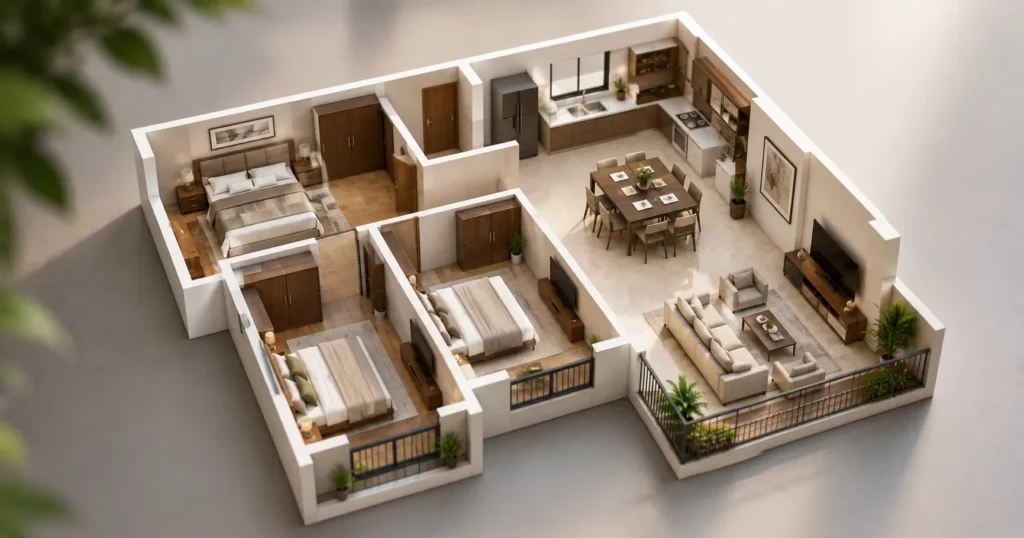
Carpet area is the usable floor space inside your apartment, the area where you can place a carpet and use it for daily living. It includes the living room, bedrooms, kitchen, dining area, bathrooms, internal passages, and store room. It excludes external walls, balconies, verandas, utility shafts, and common areas such as lift lobbies and staircases.
RERA defines carpet area as the net usable floor area, including internal partition walls but excluding external walls, balconies, open terraces, and common areas. Every RERA-registered project must disclose this figure, which lets buyers compare properties using one standard measurement instead of relying on brochure claims.
Built-up Area
Built-up area adds wall thickness, balconies, and utility areas to the carpet area. It typically runs 10% to 20% larger than carpet area, depending on wall thickness and balcony size.
Example: A 3 BHK apartment with a carpet area of 1,142 sq. ft. can have a built-up area of 1,675 sq. ft. The difference of 533 sq. ft. covers wall thickness, balconies, and utility space.
Super Built-up Area
Super built-up area, also called the saleable area, adds your proportionate share of common areas, including lobbies, lift lobbies, staircases, and clubhouse allocation, to the built-up area.
Example: The same 1,142 sq. ft. carpet area apartment can carry a super built-up area of 2,350 sq. ft., a loading factor of roughly 52%.
The gap between carpet area and super built-up area depends on the project’s loading factor, typically 25% to 40% in modern developments, though premium low-density projects with large clubhouses and wide common areas can run higher. Always compare both figures before booking, since builders price by super built-up area while you live in the carpet area.
Quick Comparison: Carpet Area vs Built-up Area vs Super Built-up Area
Each measurement covers a different portion of the property. Carpet area is usable space, built-up area adds structure, super built-up area adds common facilities.
| Feature | Carpet Area | Built-up Area | Super Built-up Area |
| Also Known As | Net Usable Area | Plinth Area | Saleable Area |
| Includes Rooms (bedroom, living, kitchen, bath) | Yes | Yes | Yes |
| Includes Internal Walls | Yes (per RERA) | Yes | Yes |
| Includes External Walls | No | Yes | Yes |
| Includes Balcony/Utility | No | Yes | Yes |
| Includes Lift, Lobby, Corridors | No | No | Yes |
| Includes Clubhouse/Gym/Pool Share | No | No | Yes |
| Represents Actual Living Space | Yes | Partially | No |
| Sale Measurement | Yes | No | No |
| Typical Pricing Use | Increasingly post-RERA | Sometimes | Often in marketing |
| Size | Smallest | Mid-range | Largest |
Summary: Carpet area is what you live in. Built-up area adds walls and exclusive balcony space. Super built-up area adds your share of common areas.
Compare properties using carpet area, not super built-up area, for the most accurate view of usable space and true value.
Difference Between Carpet Area, Built-up Area, and Super Built-up Area
Each measurement serves a different purpose. Carpet area is your daily living space, built-up area adds structural elements, and super built-up area adds shared facilities. Comparing them side by side prevents overpaying for space you cannot use.
Carpet Area vs Built-up Area
Built-up area includes wall thickness and balconies on top of carpet area, but only carpet area determines where you can place furniture.
Example: A 1,142 sq. ft. carpet area apartment with 533 sq. ft. of walls and balcony space gives a built-up area of 1,675 sq. ft. The advertised size is larger, but usable living space stays at 1,142 sq. ft.
Carpet Area vs Super Built-up Area
Super built-up area adds your proportionate share of lifts, corridors, staircases, and clubhouse space to the apartment. Carpet area belongs only to you; super built-up area includes facilities shared across the entire project.
Example: The same 1,142 sq. ft. carpet area apartment carries a super built-up area of 2,350 sq. ft. The brochure shows 2,350 sq. ft., but your actual living space remains 1,142 sq. ft.
Built-up Area vs Super Built-up Area
Both exceed carpet area, which causes confusion. Built-up area covers only your apartment and its structure. Super built-up area adds shared infrastructure such as lift lobbies, clubhouse, gym, and common corridors.
Example: A built-up area of 1,675 sq. ft. plus a 675 sq. ft. common area allocation produces a super built-up area of 2,350 sq. ft. This additional space does not belong exclusively to the owner; it represents a proportionate share of shared facilities.
Key takeaway: Carpet area matters most because it reflects actual usable space. Built-up area shows the apartment’s physical footprint. Super built-up area reflects total saleable area, including amenities. Compare the RERA carpet area, loading factor, and price per carpet square foot before choosing between projects.
What Is Included and Excluded in Each Area?
Knowing exactly what each measurement covers prevents misunderstandings during a purchase.
Carpet area includes the living room, bedrooms, kitchen, dining area, bathrooms, internal passages, store room, and internal partition walls. It excludes external walls, balconies, terraces, lifts, lobbies, common corridors, clubhouse, parking, and all shared amenities. This makes carpet area the true usable living space.
Built-up area adds internal and external walls, balcony, utility area, and private terrace to the carpet area. It still excludes lifts, lobbies, common staircases, clubhouse, gym, pool, gardens, and other shared facilities, which only enter the calculation at the super built-up stage.
Super built-up area adds your proportionate share of common infrastructure, including lift lobbies, staircases, entrance lobby, clubhouse, gym, swimming pool, landscaped gardens, and community halls, to the built-up area. This shared allocation is called the loading factor. It generally excludes public roads, municipal parks, external infrastructure outside the project boundary, and independently sold parking.
Developers calculate this loading allocation differently across projects. Always request a written breakup of carpet area, built-up area, super built-up area, and loading factor before booking, so you know exactly how much of the quoted size is your private living space.
How to Calculate Carpet Area
Carpet area equals total room area plus internal partition wall area. External walls, balconies, terraces, and common areas stay excluded.
Formula: Carpet Area = Sum of room areas + Internal wall area
If you know built-up area: Carpet Area ≈ Built-up Area − External Walls − Balcony/Terrace
Example: A 3 BHK unit with carpet area of 1,142 sq. ft. carries a built-up area of 1,675 sq. ft. and a super built-up area of 2,350 sq. ft. once common area allocation is added. Two apartments with the same advertised super built-up size can offer different carpet areas depending on loading factor.
Always compare carpet area, not super built-up area, before booking. It gives the real price per usable square foot and avoids paying extra for loading. Cross-check the brochure figure against the approved floor plan.
How to Calculate Built-up Area
Built-up area equals carpet area plus internal and external wall area plus balcony or utility space.
Formula: Built-up Area = Carpet Area + Wall Area + Balcony/Terrace Area (typically 10-20% above carpet area)
Example: A unit with 1,142 sq. ft. carpet area carries 533 sq. ft. of walls, balcony, and utility space, giving a built-up area of 1,675 sq. ft. Built-up area helps you compare apartments with similar carpet areas and judge how efficiently a layout uses space, since builders still market by super built-up area. These figures are drawn from a verified 3 BHK floor plan of a low-density luxury project in Sector 88A, Gurgaon.
How to Calculate Super Built-up Area
Super built-up area equals built-up area plus your proportionate share of common areas, including corridors, lifts, staircases, and clubhouse.
Formula: Super Built-up Area = Carpet Area × (1 + Loading Factor)
Where Loading Factor = (Super Built-up Area − Carpet Area) ÷ Carpet Area, typically 20% to 35%, though luxury projects with larger clubhouses run higher.
Example: A unit with 1,142 sq. ft. carpet area and a 51.8% loading factor gives a super built-up area of 1,142 × 1.518 = 1,734 sq. ft. for built-up, scaling to 2,350 sq. ft. once full common area share is included.
Calculating super built-up area shows how much of the advertised size is actual living space, lets you compare loading factors across projects, and helps you judge whether the amenities justify the extra charge. Always ask the developer for carpet area, built-up area, super built-up area, and loading factor before booking, and compare projects on carpet area rather than the advertised saleable figure.
What Is the Loading Factor in Real Estate?
The loading factor is the percentage of your apartment’s super built-up area made up of shared spaces rather than private living area, covering lifts, lobbies, staircases, clubhouse, gym, and landscaped gardens. A higher loading factor means you pay for more common space; a lower one means more usable area inside your apartment.
Formula: Loading Factor (%) = [(Super Built-up Area − Carpet Area) ÷ Carpet Area] × 100
Example: A unit with 1,142 sq. ft. carpet area and 2,350 sq. ft. super built-up area gives a loading factor of (2,350 − 1,142) ÷ 1,142 × 100 = 105.8% before halving for built-up split, or directly: roughly 52% when measured against built-up area alone, and approaches the higher end seen in low-density luxury developments with extensive clubhouse and landscaped space.
Typical loading factor by segment: Affordable housing runs 20-25%, mid-segment apartments 25-30%, premium projects 30-35%, luxury apartments 35-45%, and ultra-luxury developments 45% or higher.
What counts as good: 20-25% signals excellent efficiency, 25-30% is good for most projects, 30-35% is common in premium developments, and anything above 35% needs amenities substantial enough to justify it. Rather than judging loading alone, check carpet area efficiency: (Carpet Area ÷ Super Built-up Area) × 100. A healthy range sits between 70% and 80%.
Why luxury projects run higher: Grand lobbies, multiple high-speed lifts, large clubhouses, swimming pools, landscaped gardens, and concierge services all add shared built-up space. A higher loading factor is not automatically a drawback. If the amenities are well maintained and match your lifestyle, the added cost can deliver long-term value. Compare carpet area, loading factor, and amenities together rather than judging a project by super built-up area alone.
Carpet Area Ratio and Efficiency Ratio Explained
Carpet efficiency shows what percentage of super built-up area is usable carpet area. Two apartments of the same advertised size can offer different living space depending on this ratio.
Formula: Carpet Efficiency (%) = (Carpet Area ÷ Super Built-up Area) × 100
Example: A 1,142 sq. ft. carpet area against a 2,350 sq. ft. super built-up area gives roughly 49% efficiency.
Typical range by segment: Affordable housing, 75-80%. Mid-segment, 72-78%. Premium, 70-75%. Luxury, 65-75%. Ultra-luxury, 60-70%.
Above 80% is excellent, 70-75% is healthy for premium projects, and below 70% signals higher loading, common in low-density luxury developments with large clubhouses. Compare carpet efficiency, not advertised size, alongside loading factor and price per carpet square foot.
Why RERA Made Carpet Area the Standard
Before RERA, builders advertised projects using super built-up or built-up area, with no uniform measurement, making comparisons difficult. The Real Estate (Regulation and Development) Act, 2016 made carpet area the legal standard for selling apartments. Every RERA-registered project must now disclose carpet area using one definition.
RERA’s definition: The net usable floor area, excluding external walls, service shafts, exclusive balcony, and open terrace, but including internal partition walls.
This brought four changes: a uniform measurement across builders, easier comparison between projects, reduced misleading advertising, and accurate price-per-square-foot calculation. If a builder delivers less carpet area than promised, RERA requires a refund with applicable interest under state rules. If delivered area increases, the buyer pays only for the additional space at the agreed rate.
Builders must disclose carpet area in the project registration, sales brochure, Builder-Buyer Agreement, allotment letter, sale agreement, and approved floor plans. Always verify this figure on the state RERA portal before booking.
Why Carpet Area Matters More Than Super Built-up Area
Super built-up area looks larger because it includes shared spaces you don’t exclusively use. Carpet area reflects your actual living space and directly affects daily comfort, furniture placement, and value for money.
Better comparison: Two units with the same super built-up area can carry different carpet areas due to differing loading factors. Comparing carpet area, carpet efficiency, and loading factor together gives an accurate picture instead of relying on advertised size.
Better value: Price per square foot calculated on carpet area shows what you actually pay for living space, not shared infrastructure. A unit with lower loading and higher carpet efficiency often delivers better long-term value than a larger-looking apartment with excess common area.
Better furniture and resale planning: Higher carpet area supports better room sizing, storage planning, and layout flexibility. It also strengthens resale value, since informed buyers increasingly compare carpet area and efficiency rather than advertised size alone.
Carpet area should be your primary benchmark. Super built-up area works best as a pricing and common-area reference, not a measure of the home you actually live in.
Why Builders Mention Super Built-up Area
Super built-up area covers your apartment plus your share of shared spaces, lifts, lobbies, staircases, clubhouse, gym, pool, gardens, and corridors. RERA requires carpet area disclosure, but builders still quote super built-up area because it reflects the full saleable area and shows what your money funds beyond your own four walls.
You don’t own the lobby or clubhouse outright, but you pay toward building and maintaining them. Projects with more amenities carry a higher loading factor and a larger super built-up figure. Still, carpet area remains your real benchmark. Compare projects on carpet area, carpet efficiency, loading factor, and price per carpet square foot, not the headline super built-up number.
How to Compare Two Apartments Correctly
Don’t compare apartments by super built-up area or total price alone. Compare these instead:
Carpet area first. Two units can share the same super built-up size but differ in actual living space. Always check carpet area before anything else.
Price per carpet square foot. Divide total price by carpet area. A unit priced lower per carpet square foot delivers more usable space for the same money, even if the headline price looks identical.
Loading factor. Below 25% is excellent, 25-35% is good for most projects, 35-45% is common in premium developments, and above 45% needs a closer look. Higher loading isn’t automatically bad if the amenities justify it.
Layout efficiency. A well-planned 1,400 sq. ft. apartment can feel larger than a poorly designed 1,500 sq. ft. unit. Check for minimal wasted corridor space, regular room shapes, good natural light, and practical furniture placement.
Usable space. Walk through whether the living room fits your furniture, bedrooms are practical, storage is adequate, and balconies are genuinely usable, not just decorative.
Common Mistakes Homebuyers Make
Buyers often compare only the super built-up area, missing that two “2,000 sq. ft.” apartments can carry very different carpet areas due to differing loading factors.
Many skip checking the loading factor entirely. A unit at 25% loading delivers noticeably more usable space than one at 42%, even at the same advertised size.
Some never verify the RERA carpet area against the brochure figure, a simple cross-check that prevents disputes later. Others accept only the super built-up number without requesting a full breakup of carpet area, built-up area, balcony, utility, and common area allocation.
Finally, comparing only total price hides the real picture. Price per carpet square foot reveals which unit actually offers better value.
Before booking, confirm you have: carpet area, price per carpet square foot, loading factor, carpet efficiency, RERA verification, a complete area breakup, and the actual usable layout, not just the advertised size.
Questions Every Homebuyer Should Ask the Builder Before Booking
Before booking, get clear answers across these areas.
Area and space: What’s the exact RERA carpet area? What are the built-up and super built-up areas? What’s the loading factor and carpet efficiency? Is the balcony part of carpet area or only built-up area?
RERA and legal: What’s the RERA registration number? Can I verify it on the official portal? Are all approvals in place? Any pending legal disputes?
Pricing: Is the quoted price based on carpet area or super built-up area? What’s the price per carpet square foot? What additional charges apply, GST, PLC, club membership, maintenance deposit?
Amenities: Which common areas count toward the loading factor? Will all promised amenities be ready before possession?
Layout and construction: Can I see the approved floor plan? What are the exact room dimensions, ceiling height, and facing direction? What are the flooring, fitting, and finishing specifications?
Possession: What’s the expected possession date? What compensation applies if delayed? What’s the current construction stage?
Parking, maintenance, loans: Is parking included and covered or open? What’s the estimated monthly maintenance? Which banks have approved the project for home loans?
After possession: What’s the defect liability period under RERA? How are construction defects reported and resolved?
Before paying the booking amount, confirm the RERA carpet area, full area breakup, loading factor, approved floor plan, total cost including extras, possession timeline with compensation clause, and the Builder Buyer Agreement. First-time luxury buyers can complement this checklist with a broader buying framework covering project selection, payment plans, and possession planning.
How to Verify Carpet Area Before Buying
Check RERA registration. Compare the carpet area on the official state RERA portal against the builder’s brochure. Any mismatch needs a written explanation before you proceed.
Verify the floor plan. Request the approved floor plan and check room dimensions against the claimed carpet area. A well-designed layout maximizes usable space with minimal wasted corridors.
Read the sale agreement. Confirm it states the RERA carpet area, built-up area, super built-up area, and loading factor. Under RERA, a shortfall in delivered carpet area entitles you to a refund with interest; an increase means you pay only for the additional space at the agreed rate.
Measure the sample apartment. Use a tape or laser meter to check room dimensions against the floor plan, even if interiors are upgraded for display.
Verify builder documents. Cross-check the RERA certificate, approved building plans, area calculation sheet, and Builder Buyer Agreement for consistency.
Carpet Area in Luxury Apartments
Luxury projects often carry a different area equation than mid-segment housing. A larger super built-up area in a premium project usually reflects extensive amenities, not necessarily more carpet area. Some low-density luxury projects on Dwarka Expressway, for example, offer only four residences per core, which directly reduces common corridor area per apartment and can improve the overall loading equation.
Why loading runs higher: Grand lobbies, multiple high-speed elevators, large clubhouses, landscaped gardens, wellness centers, and concierge services all add shared space. This isn’t automatically a downside; the real question is whether these facilities add genuine value.
Balconies matter more here. Luxury homes increasingly treat balconies as functional outdoor space, sit-outs, decks, and private terraces, rather than narrow extensions. These improve ventilation and daylight but stay excluded from RERA carpet area, since they fall under built-up area.
Clubhouse size drives loading. A larger, more comprehensive clubhouse pushes super built-up area higher. Evaluate whether you’ll actually use these facilities regularly rather than judging the project on loading factor alone.
What to evaluate beyond size: carpet efficiency, balcony usability, privacy between units, units per floor, lift-to-resident ratio, clubhouse scope, and floor plan efficiency, together, not the advertised size in isolation.
Buyers comparing luxury projects along the Dwarka Expressway corridor, including emerging sectors such as Sector 88A, should evaluate carpet efficiency and loading factor alongside location fundamentals before shortlisting. Buyers evaluating premium apartments in growth corridors should understand the infrastructure drivers behind specific micro-markets before committing, as covered in detail in our guide to the Dwarka Expressway real estate corridor.
Which Area Should You Focus On Before Buying?
Use all three measurements together, in this order of priority:
- Carpet area – the actual space you’ll live in daily.
- Layout efficiency – how well that space is planned.
- Price per carpet square foot – the real cost of usable space.
- Loading factor – how much you’re paying for shared infrastructure.
- Amenities – whether the loading is justified by what you’ll actually use.
A loading factor up to 25% reflects efficient planning; 25-35% is typical for quality projects; 35-45% is common in luxury developments with premium amenities; above 45% needs a closer look at what you’re getting in return. In projects with fewer units per floor, the common corridor allocation per apartment tends to be lower, which can improve carpet efficiency even at higher super built-up sizes. Buyers evaluating luxury apartments in Gurgaon can use a structured checklist covering location, builder, construction quality, and legal verification before booking a process explained in detail in our complete luxury apartment buyer’s guide.
Myths About Carpet Area and Super Built-up Area
Myth: A bigger super built-up area means a bigger home. Reality: it often reflects more shared space, not more living area. Two units advertised at the same size can have very different carpet areas.
Myth: Carpet area and built-up area are the same. Reality: built-up area always exceeds carpet area, since it adds wall thickness and balconies.
Myth: Builders charge only for carpet area. Reality: most projects price by super built-up area, so you pay for your share of common facilities too.
Myth: A higher loading factor is always bad. Reality: it can reflect genuine lifestyle amenities. The question is whether they add value for you.
Myth: Luxury apartments always offer better carpet efficiency. Reality: luxury projects often have larger common areas and balconies, which can mean lower, not higher, carpet efficiency.
Myth: The lowest price per square foot is the best deal. Reality: that figure is usually based on super built-up area. Price per carpet square foot tells the real story.
Expert Tips to Avoid Overpaying
Compare carpet area, not super built-up area, as your primary benchmark. Calculate price per carpet square foot rather than relying on the advertised rate. Ask for the loading factor and question anything unusually high. Evaluate carpet efficiency and layout quality, not just size. Verify the RERA carpet area independently rather than trusting brochures. Request a complete written area breakup. Always compare projects using the same measurement standard. Inspect the sample apartment for room dimensions, storage, and natural light, not just finishes. Consider whether amenities justify the loading you’re paying for. Don’t choose purely on lowest price; factor in construction quality, location, and resale potential. Review the sale agreement for area variation and refund clauses before signing. Plan for future needs, family growth, work-from-home space, and resale demand, not just today’s requirements.
Frequently Asked Questions
What is the difference between carpet area, built-up area, and super built-up area?
Carpet area is usable floor space. Built-up area adds walls and balconies. Super built-up area adds your share of common facilities like lobbies and clubhouse.
Which area should I focus on before buying a flat?
Carpet area first, since it reflects the space you’ll actually use daily.
What is RERA carpet area?
The net usable floor area, including internal partition walls, excluding external walls, balconies, and common areas, as legally defined under RERA.
Does carpet area include balconies?
No. Balconies, verandahs, and open terraces stay excluded under RERA, even for exclusive use.
Why do builders advertise super built-up area?
It reflects the total saleable area, including shared amenities, though carpet area remains the key figure for comparing usable space.
What is the loading factor?
The percentage difference between carpet area and super built-up area, representing your share of common spaces.
What is a good loading factor?
Generally 20-30% for most projects; premium and luxury developments often run higher due to larger shared amenities.
How do I compare two apartments correctly?
Compare carpet area, price per carpet square foot, loading factor, layout efficiency, and room dimensions, not just the advertised size.
Can two apartments with the same super built-up area have different carpet areas?
Yes, depending on each project’s loading factor and planning efficiency.
How does RERA protect homebuyers?
By mandating standardized carpet area disclosure and requiring compensation if delivered area falls short of what was promised.
Why do luxury apartments often have higher loading factors?
Larger clubhouses, multiple pools, landscaped gardens, and premium lobbies increase shared space allocation.
Should I compare price per super built-up square foot or carpet square foot?
Price per carpet square foot, since it reflects the actual usable space you receive.
Can carpet area change after construction?
Minor variations may occur and must follow RERA provisions and the sale agreement terms.
Why is carpet efficiency important?
It shows how much of the total area is genuinely usable, directly affecting comfort and value for money.
What’s the biggest mistake buyers make?
Judging a property only by super built-up area or price per square foot instead of carpet area, loading factor, and efficiency together.
Final Thoughts
Carpet area, built-up area, and super built-up area each serve a different purpose. Carpet area shows what you’ll actually use. Built-up area adds structural elements. Super built-up area reflects your share of shared infrastructure.
RERA has improved transparency by mandating carpet area disclosure, but comparing properties on advertised size or super built-up price per square foot still leads buyers astray. Focus on RERA carpet area, loading factor, carpet efficiency, and price per carpet square foot to judge true value.
Premium developments often carry higher loading because of larger clubhouses and landscaped spaces. That isn’t a flaw by itself; evaluate whether those shared spaces genuinely fit your needs. A well-informed buyer chooses the apartment with the best usable space and transparent pricing, not the biggest number on the brochure.